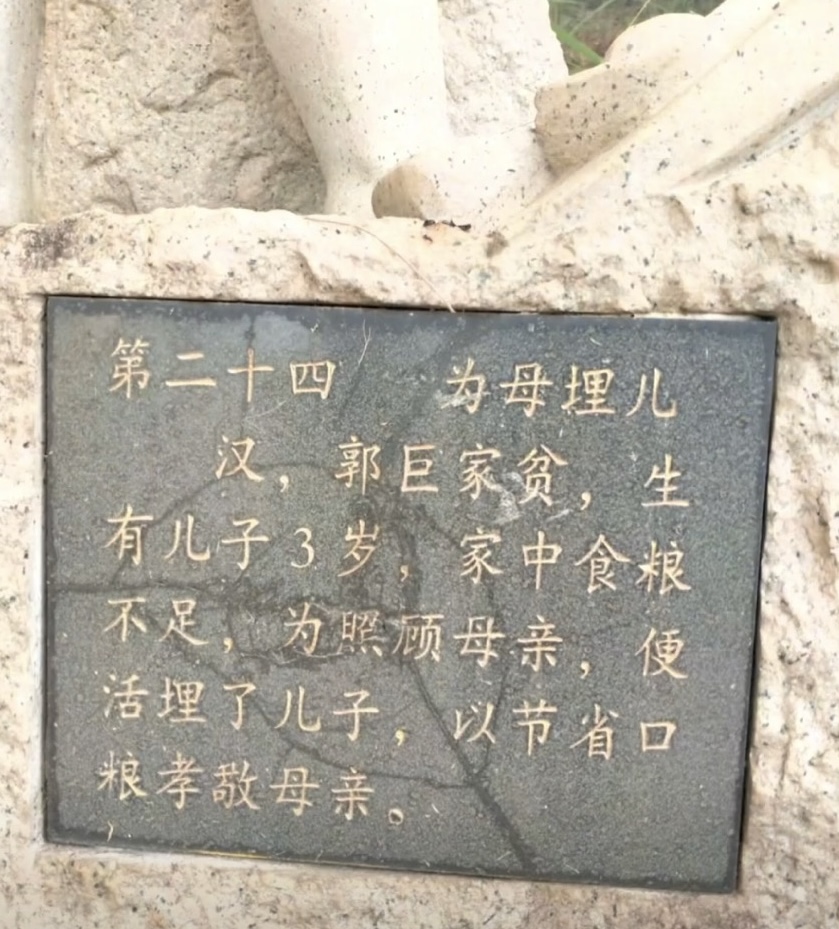
Guo Ju (郭巨) occupies a prominent place in the canon of filial piety tales for his extreme act: the intention to kill his three-year-old son so that scarce food could instead be given to his mother. Although both Guo Ju and the episode may be entirely apocryphal, the story’s enduring cultural reach has been considerable. Its influence—often criticized as misguided or even harmful—illustrates the powerful, long-lasting force of filial ideology in Chinese society.
Filial piety is a central tenet of Chinese culture. Chairman Mao effectively suppressed it during the Cultural Revolution. But as the economy revived under Deng Xiaoping, and people could once again reliably have a bowl of rice—especially a hot bowl—their spiritual needs (精神需求) began to grow. Many old traditions became newly appreciated and even fashionable again, including filial piety.
孝道是中国文化的核心信条之一. 毛主席在文革期间有效地压制了它.但随着邓小平领导下经济的复苏,人们又能稳定地吃上一碗米饭——尤其是一碗热腾腾的米饭——他们的精神需求开始增长. 许多古老的传统重新受到重视,甚至再次流行起来,孝道便是其中之一.
第二十四 为母埋儿
汉,郭巨家贫,生有儿子3岁,家中食粮不足,为照顾母亲,便活埋了儿子,以节省口粮孝敬母亲.Twenty-Four Burying the Son for His Mother
During the Han Dynasty, Guo Ju was poor and had a three-year-old son. His family lacked food, so to care for his mother, he buried his son alive to save food for her.
Be First to Comment